The mic you already have
Your UMIK-1 has a second job
The app recognises a connected USB reference microphone. On the Studio plan it loads the mic’s calibration file — the same one you use for room correction — and shows raw per-tone decibel figures alongside the score.
Nothing to buy. The mic you bought for the inside of the room now measures what escapes it. The built-in microphone works too; the reference mic tightens the numbers.
Which pitch escapes
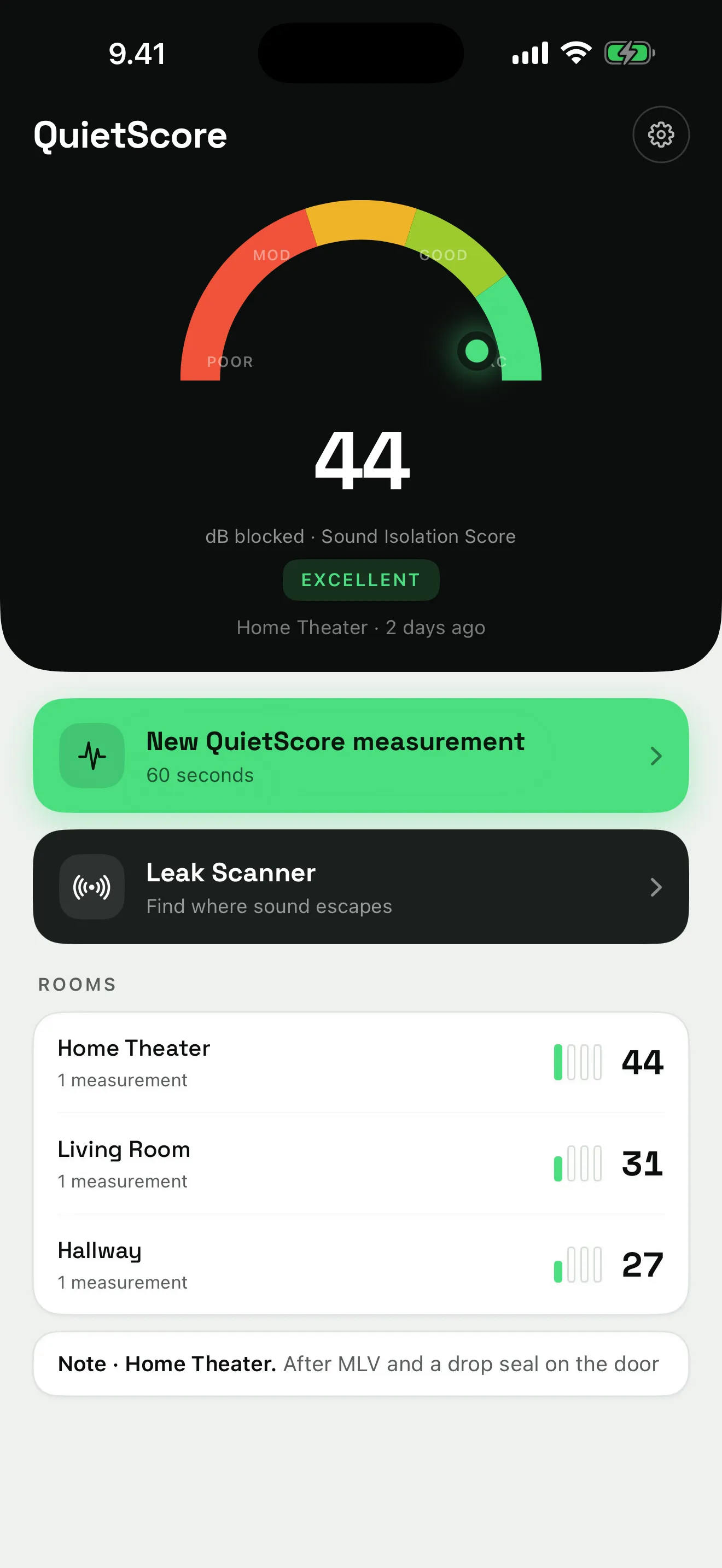
Bass is the complaint. The breakdown shows it.
The four-tone breakdown covers 125 Hz, 500 Hz, 1 kHz and 4 kHz. The 125 Hz tone is where a door gives up first and where most of the family’s complaints live. The app doesn’t measure below 125 Hz, so deep sub-bass through the structure is outside what a door score can tell you.
Read the breakdown, not just the band
The composite is weighted for speech, so the 125 Hz tone counts for a tenth of it. A door can sit in Good and still be the reason someone upstairs can hear the explosions.
One honest caveat. Every door has a dip of its own somewhere around 125 to 200 Hz, from the panel’s own resonances rather than from its weight. Adding mass is the right lever most of the time, but it isn’t a guarantee in that band.
What to expect. A solid-core door with perimeter seals is usually rated 30 to 35, and 33 to 38 once mass-loaded vinyl goes on it. Getting past that takes a genuine acoustic assembly at 35 to 50. Those are published ratings for each door type, not QuietScore measurements.
How to use it while you build
One number per build step
Score it bare first Score the door before you touch anything
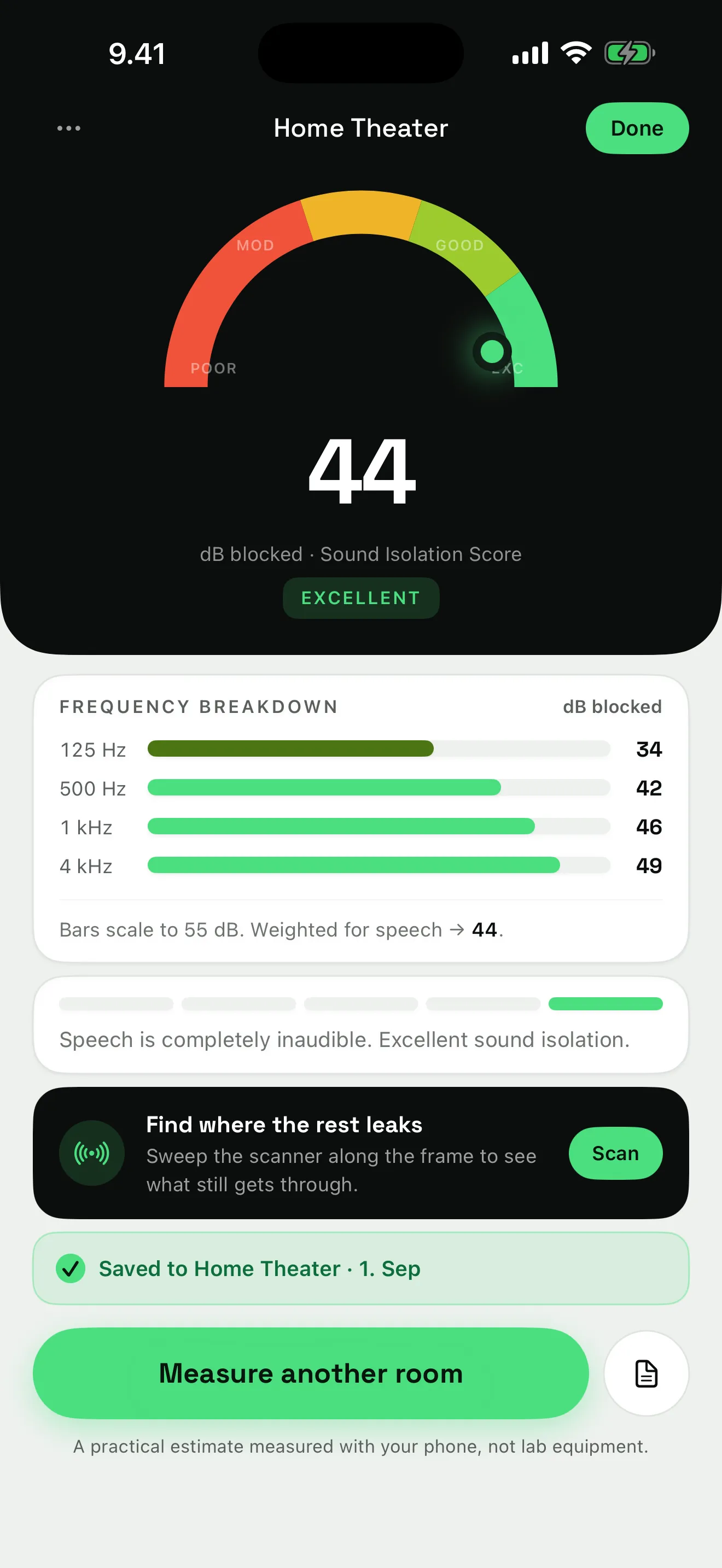
Save to a "theater" room, note "bare door". Save it to a room called "theater", note "bare door". That is the number every later step gets measured against.
Score after each step Score again after every step
Seal, add mass, swap the door. One at a time. Seal, add mass, swap the door — one at a time. History lines the numbers up so you can see which step was worth the weekend.
Anything bigger than about 2 dB is a real gain, not spread.
Sweep the penetrations Sweep the penetrations, not just the door
Seals, threshold, outlets, HVAC grille. Door seals, the threshold, the outlet boxes, the HVAC grille. The scanner reads live against a baseline spot and marks the hot ones.
Export the PDF Export the PDF when you’re done
The record of what the room does. It’s the record of what the room does, and the answer for whoever asks whether all that work made a difference.
Leak Scanner
Sound rarely goes through the wall. It goes through the outlet.
Phone upside-down, bottom mic at the seam, a tone playing inside the theater. Sweep the door frame, then the wall penetrations. The scanner locates the leak; it never scores the wall, because a score needs something you can open and close.
What you need for this job
Home covers the build, Studio adds the mic
Home gives you unlimited scores, the breakdown, rooms with history and notes, the full Leak Scanner and PDF. Studio adds the raw dB figures and applies your USB reference mic’s calibration file.
Mass-loaded vinyl on the door is $40–$80.
An acoustic seal kit with an automatic door bottom is $370–$980.
A purpose-built acoustic assembly is $2,800–$5,000.
A month of Studio is $9.99, and it tells you which of those the room needs next.
Costs are typical US figures for comparison, not quotes.
Questions
Works with a UMIK-1? Does it work with the UMIK-1?
Yes. Connect it, and on the Studio plan import its calibration file in Settings. The app applies the per-frequency offsets to the four tones.
How loud are the tones? The tones are loud. How loud?
Near 90 dB inside the room for a door that blocks 40. The app warns you about pets, children and anyone asleep before it starts. It’s a sixty-second test.
What should a theater door score? What does a well-built theater door score?
A solid-core door with perimeter seals is usually rated 30 to 35, and 33 to 38 with mass-loaded vinyl added. Excellent normally takes a genuine acoustic assembly. The breakdown matters more than the band here: watch the 125 Hz tone, because that’s the one the rest of the house hears.
Added mass, 125 Hz didn’t move? I added mass and 125 Hz barely moved.
That band is where a door’s own panel resonances live, and mass law doesn’t govern it the way it governs the rest of the range. Check the seals and the threshold before adding another layer, and watch 500 Hz and 1 kHz to confirm the mass did something.
Can it score a wall? Can it score the whole room, or the wall to the bedroom?
It scores the door, or any barrier you can open and close, because the score is the difference between open and closed. For the wall, the Leak Scanner shows where sound gets through — it doesn’t score it.
Is this an STC test? Is this the same as an STC test?
No. It’s a practical estimate on a scale comparable to professional STC ratings, measured with your phone and your mic instead of lab equipment. Repeatable enough to show that a build step worked. More in Support.
Measure what leaves the room
- The next step is $40–$80 in mass-loaded vinyl, $370–$980 in seals, or $2,800–$5,000 in door. This tells you which one the room needs.
- Mass on a wall does nothing for a door that leaks at the threshold. The breakdown and the scanner say which it is.
- Sealed solid-core doors are usually rated 30 to 35, and 33 to 38 with vinyl. Acoustic assemblies reach 35 to 50.
- Every layer you add hides the number underneath it.
Sixty seconds, the mic you already own, first 3 scores free.