The number you should have before quoting
Start with a baseline
Most people replace a door without knowing what the old one blocked. Then the new one arrives and the only measure is whether the room feels quieter, which it always does for about a week.
A baseline turns the purchase into a before and after. It also gives you something to say to the supplier: this is what we have, what should we expect from yours.
Doors like this are usually rated
- Hollow-core, unsealed
- 20–25 · Moderate
- Hollow-core, weatherstripped
- 23–26 · Moderate
- Solid-core, fully sealed
- 30–35 · Good
- Acoustic assembly
- 35–50 · Excellent
Published STC ratings for each door type, not QuietScore measurements. Field performance runs below the lab number, which is the whole reason to measure.
Sometimes it’s not the door
A gap costs less than a leaf
The four-tone breakdown shows which pitches leak. Crisp sound getting through points at the gaps first, because a gap has almost no transmission loss and a door blocks high pitches best — so a gap costs you the most exactly where the door was strongest. Dull, low sound points at the weight of the leaf, and sealing will help less there.
It tells you where to look first, not what is certainly true. Home and above.
What each answer costs
- Weatherstrip-grade seal kit
- ~$80
- Acoustic kit with automatic door bottom
- $370–$980
- Mass-loaded vinyl on the door you have
- $40–$80
- Solid-core swap, installed
- ~$650
- Acoustic assembly, installed
- $2,800–$5,000
The measurement that tells you which one you need is free. Typical US figures for comparison, not quotes.
How to plan it
Four steps, spread over the job
Score what you have Score the door you have
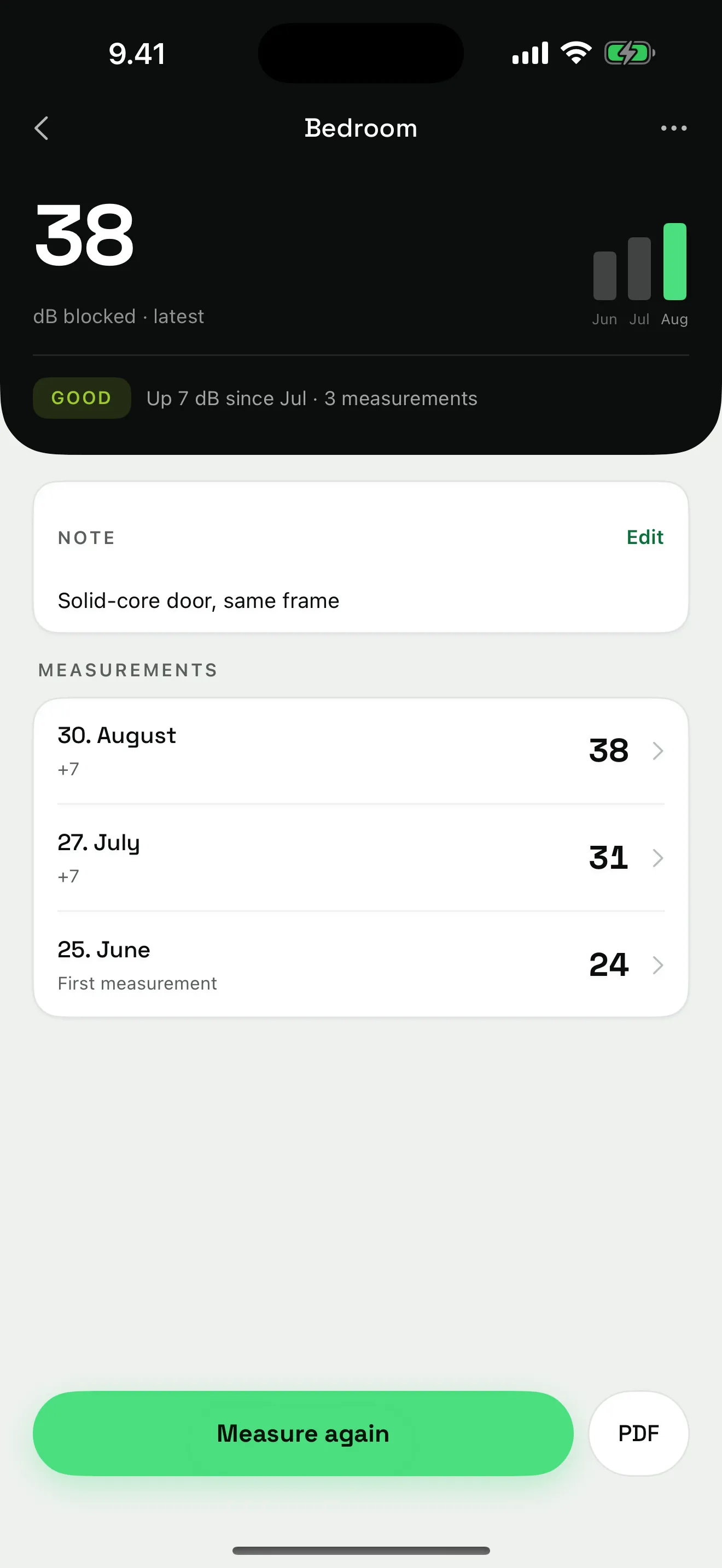
Save it to the room, note "before". Sixty seconds. Save it to the room with a note: "before". Sixty seconds, and the first 3 scores are free.
Read it, sweep it Read the breakdown and sweep the frame
Seals, a door, or both? Home and above. Decide whether you are buying seals, a door, or both. Home and above.
Sweep before they leave Sweep the new frame before the installer leaves
A seal that misses the floor is free to fix now, $125–$200 later. A drop seal that isn’t meeting the floor is a five-minute fix while they’re still there, and a $125–$200 service call once they’ve gone.
This is the five minutes that pays for the whole exercise.
Score the new one Score the new door
Same spot, same volume. Over about 2 dB is real. Same spot, same volume. History shows every step side by side, and anything bigger than about 2 dB is a real change.
Leak Scanner
Installation day, checked in five minutes
Set a baseline spot on the frame and sweep the seals and the threshold. Any spot that jumps is a gap the installer can still fix. It locates leaks; it doesn’t score the door, and it never scores a wall.
What you need for this job
Free gives you the baseline and the after
Home keeps them in a room with history and notes, adds the breakdown that tells a gap from a leaf, the full Leak Scanner, and the PDF you can show the supplier. You’re weighing $80 in seals against a $3,500 door — a month of Home is $4.99, and the baseline itself is free.
Questions
What should it score? What score should a good soundproof door get?
A fully sealed solid-core door reaches 30 to 35, and a genuine acoustic assembly is rated 35 to 50 depending on class. Your baseline is still the better yardstick: the question is how far the new door moves you, not whether it hits a particular number.
Is solid-core enough? Is a solid-core door a soundproof door?
Not on its own. A solid-core slab installed runs about $650 and gets you to roughly 30 to 35 once it’s properly sealed. An acoustic assembly with a published rating, pre-hung with seals and an automatic door bottom, is $2,800 to $5,000. Both get called "soundproof doors", which is why a baseline is worth sixty seconds.
Compare it with STC? Can I compare my score with the door’s STC rating?
The score is a practical estimate on a scale comparable to professional STC ratings, but it isn’t an STC rating. Lab numbers describe the leaf in a test wall; your score describes your doorway, seals and threshold included.
How small a change counts? How small a change is worth believing?
About 2 dB. Background noise, where you stood and the speaker’s volume all move the reading a little, so anything inside that is ordinary spread rather than a real gain.
What if it’s the wall? Will a new door fix noise coming through the wall?
Not if the wall is the weak point. The Leak Scanner will show you where sound gets through a wall, so you can find out before you order.
Old door already gone? The old door is already gone. Can I still get a before?
No, and that’s the one number you can’t get back. Score the new door as soon as it’s in, and sweep the frame. That still tells you whether the install is right, which is the second thing you were paying for. More in Support.
Get your baseline before you get a quote
- "Soundproof door" means an $80 seal kit or a $3,500 assembly. You’re about to pick one.
- If the leak is a gap, seals would have done it. If it’s the leaf, seals would have done nothing.
- Hollow-core doors are usually rated 20 to 26. Sealed solid-core reaches 30 to 35. Acoustic assemblies are 35 to 50.
- The old door can only be measured while it’s still hung.
Sixty seconds, a speaker you already own, first 3 scores free.