Why the rating and the result differ
A rated door is a promise about the leaf, not the doorway
Laboratory ratings come from a test wall with a perfect seal on every edge. Your frame is not that wall.
The arithmetic
The door manufacturer TruStile publishes it plainly: an eighth of an inch of clearance around the edges takes an STC-52 door down to an effective 21. A standard three-quarter-inch undercut is about one percent of the door’s area, and one percent of open area caps the whole doorway near 20 dB — no matter what the door is made of.
That is why an expensive door can land at Moderate, and why the fix is usually cheap. QuietScore measures the whole opening — leaf, seals, threshold and frame together — as a practical estimate on a scale comparable to professional STC ratings.
What to expect. Acoustic doors are usually rated 35 to 50 depending on class, and field performance runs below the lab number. If yours is sitting in Moderate, the next two sections tell you where to look.
How to check it
Four steps, one of them optional
Score it as installed Score the door as installed
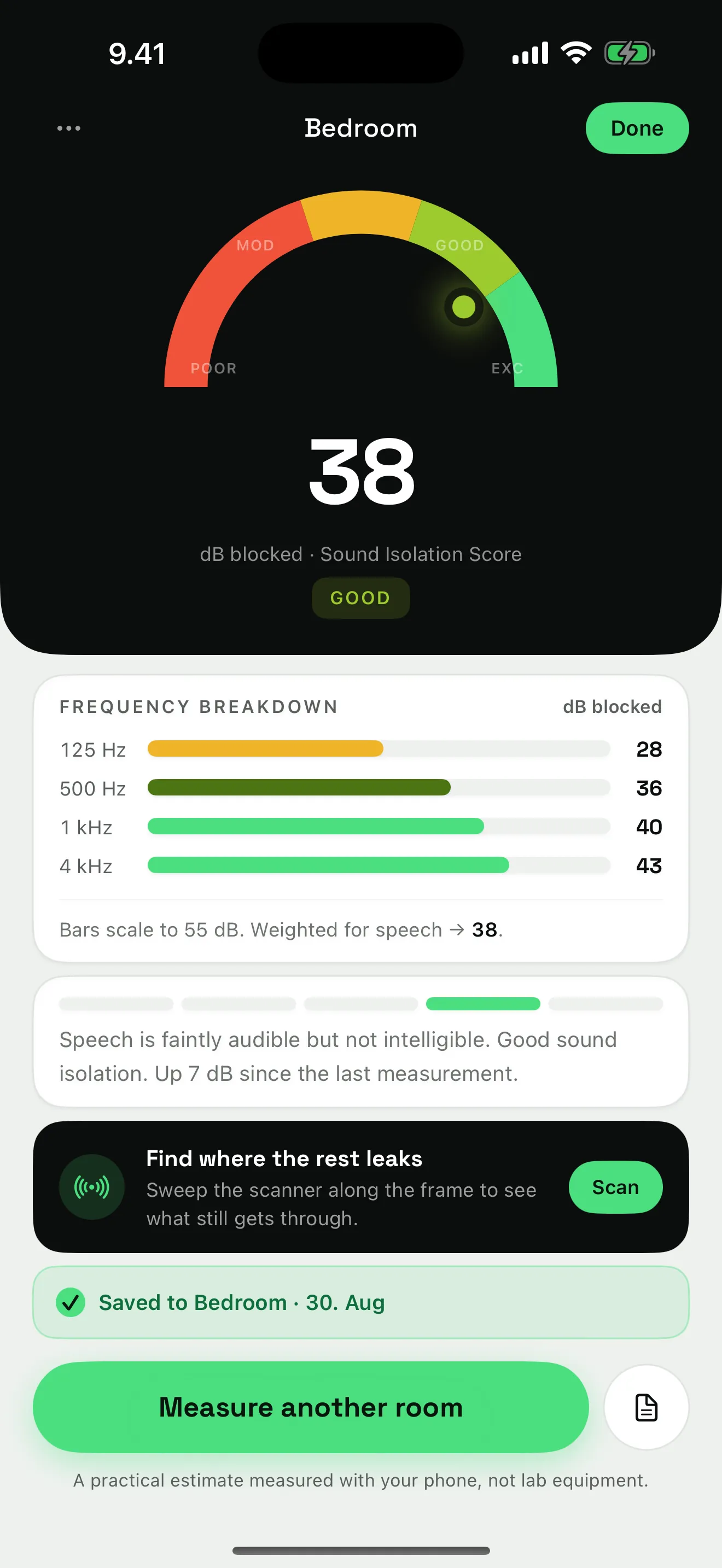
Speaker inside, one reading open, one closed. Sixty seconds. Speaker inside, door open, take a reading. Close the door, take the second. Sixty seconds, and the first 3 scores are free.
Read the breakdown Read the four-tone breakdown
Crisp sound points at a gap, dull low sound at the leaf. Home and above. Crisp sound getting through points at the gaps first. Dull, low sound points at the leaf and what surrounds it. Home and above.
Sweep the frame Sweep the frame with the Leak Scanner
Hinge side, latch side, head, threshold. Mark what jumps. Hinge side, latch side, head, then the threshold. Mark every spot where the reading jumps, and the marks become a findings list.
Most install problems are one hot spot, not a leak everywhere.
Fix it, score again Fix it, then score it again
Same spot, same volume. Over about 2 dB is a real change. Same spot, same volume. Anything bigger than about 2 dB is a real change; smaller than that is ordinary spread.
Leak Scanner
It finds the gap. It doesn’t grade the door.
Phone upside-down, bottom microphone at the seam, tone playing from inside. Set a baseline on a quiet part of the frame and everything else reads relative to it. Most installation problems show up as one hot spot along the bottom or one side, not a leak everywhere.
What you can hand over
Two numbers and a findings list
A PDF with the score before the adjustment, the score after, the four-tone breakdown and the marked spots. It’s an estimate measured with a phone, and the report says so on every page, so nobody is arguing about a certificate. It is specific enough to make the conversation about the threshold instead of about whether you’re imagining it.
What you need for this job
Free answers the first question
The free tier tells you whether the door is doing what you paid for. Home adds the breakdown that separates a gap from a thin leaf, the full Leak Scanner and the PDF. Business puts your name on the report if you’re the installer.
The assembly was $2,800–$5,000 installed.
The automatic door bottom that makes it work is $60–$205.
A month of Home is $4.99, and the first three scores are free.
Costs are typical US figures for comparison, not quotes.
Questions
Is this an STC rating? Will it tell me the door’s STC rating?
No. STC comes from a laboratory with calibrated equipment and a standard test wall. QuietScore measures your actual door in your actual frame and tells you what that’s comparable to. Useful for deciding what to fix, not for compliance.
What should it score? What should a properly installed sound-rated door score?
Acoustic doors are usually rated 35 to 50 depending on class, and what you measure in a real doorway sits below the lab figure. Your own before-and-after is the better yardstick: score it, fix the gap, score it again.
Score far below the rating? My score is far below what the door was rated for. Is the door faulty?
Usually it’s the doorway, not the leaf. An eighth of an inch of clearance is enough to take a top-rated door down to around 21, so sweep the frame first. Also check your speaker’s own volume knob, and Reduce Loud Audio in iOS Headphone Safety.
It said the speaker was too quiet The measurement stopped and said the speaker was too quiet.
That’s the tone not surviving the trip, and a genuinely good door is the most likely thing to cause it. Turn the speaker up, including its own knob, and run it again from the open-door reading.
Can I use it in a dispute? Can I use the report in a dispute with the installer?
Use it to show where the leak is and what changed after a fix. It is a practical estimate, not a certified measurement, and the report says so on every page. For a contractual or legal claim you need a professional field test.
Door fine, still noisy? The door is fine but I still hear everything.
Then the sound is going around it. The Leak Scanner will locate leaks in a wall, an outlet or a duct — it doesn’t score them, because a score needs something you can open and close. More in Support.
Find out what the door is really doing
- You paid $2,800–$5,000 for quiet. This tells you whether the doorway delivered it.
- An eighth of an inch of clearance can take an STC-52 door down to an effective 21. The part that fixes it costs $60–$205.
- Acoustic doors are usually rated 35 to 50. The hollow-core door yours replaced was 20 to 25.
- The favour expires. The gap doesn’t.
Sixty seconds, a speaker you already own, first 3 scores free.